
Category: Optimal Behavior
Social Context: “How People Influence Each Other”
Join us on Thursday, May 16, 2024 from 10:30 to 11:00 CDT (4:30 to 5:00 BDT) for the fifth webinar in Humaculture, Inc.’s “Optimal Behavior: Making Optimal Behavior the Natural Choice.” You will learn why and how the Social Context within an Organization impacts performance and well-being and how it can be used to grow capabilities, inspire motivation, overcome barriers, and resist temptations to lead to Optimal Behavior.
Presenters
- Steve Cyboran, ASA, MAAA, FCA, CEBS, actuary and strategy consultant
- Wes Rogers, Humaculturist® and strategy consultant
- Colin Bullen, ASA, behavior change actuary
- Hanlie van Wyk, behavior change consultant
Objective
In this fifth session in our series on Optimal Behavior, we explore how the Social Context influences behavior and change. To achieve Optimal Behavior, attempts to change require the support of People along the way. The powerful influence of our friends, families, colleagues, bosses, and social connections is around us all the time. In the workplace, change rarely happens unless there are early adopters who visibly engage in the new behavior for others to copy – acting as a role model for the desired Optimal Behavior. These early adopters, who are known by many names including ‘Change Agents’ or ‘Champions’, provide an energy that Inspires Motivation while demonstrating to People like them that change is possible, which builds confidence. Companies successfully moving toward Optional Behavior will connect People to build willpower and make very clear the expectations of everyone involved. Finally, new ways of behaving should be reinforced by creating a new corporate hero archetype who succeeds by demonstrating Optimal Behaviors, not others!
“It was only a sunny smile, and little it cost in the giving, but like morning light it scattered the night and made the day worth living.” – F. Scott Fitzgerald
Social Context Key Takeaways
Join us to learn:
- How ineffective organizations fail to:
- Understand the power of social connection
- Create conditions to make connections natural
- Reinforce the messages to keep people on track
- How effective organizations:
- Leverage social contagion and champions
- Create opportunities for natural interaction
- Celebrate early adopters and share willpower
Available Support
We are available to support you in your strategy, design, compliance, financial, and monitoring needs. Our team includes business and human relations leaders, finance experts, actuaries, clinicians, behavioral health experts, pharmacy experts, and legal resources to guide you through the strategy and compliance process. Please contact us: [email protected].
Systems Context: “The Systems that Govern Behavior”
Join us on Thursday, March 21, 2024 from 10:30 to 11:00 CDT for the third webinar in Humaculture, Inc.’s “Optimal Behavior: Making Optimal Behavior the Natural Choice.” You will learn why and how the Systems employed in an Organization impact performance and well-being and how they can be used to grow capabilities, inspire motivation, overcome barriers, and resist temptations to lead to Optimal Behavior.
Presenters
- Steve Cyboran, ASA, MAAA, FCA, CEBS, actuary and strategy consultant
- Wes Rogers, Humaculturist® and strategy consultant
- Colin Bullen, ASA, behavior change actuary
- Hanlie van Wyk, behavior change consultant
Objective
In this fourth session in our series on Optimal Behavior, we explore how the Systems context influences behavior and change. To be able to evolve towards Optimal Behavior, people need to be surrounded by Systems that support them on their journey. The Systems context contains all the tools and guidelines that help us on our way every day. In the workplace these are policies and procedures, enterprise resource management Systems, pay, benefits, and rewards, as well as that curious thing we often refer to as “the way we do things around here.” Anything that signals the optimal way to behave in each Organization. If any of those Systems are misaligned with the Optimal Behavior you’re trying to achieve, your change efforts will fail. The Organizations that recognize this know how to adjust those Systems, including when to bring things into the public eye and when to keep them quiet. They will also be aware that rewards for engagement need to drive intrinsic motivation if the Organization is to develop optimal habits that last.
“A bad system will beat a good person every time.” – W. Edwards Deming
Systems Context to Promote Optimal Behavior Key Takeaways
Join us to learn:
- How ineffective Organizations employ Systems that:
- Limit growth and development
- Lead to discouragement and apathy
- Create unintended barriers or temptations
- How effective Organizations:
- Build habits into processes
- Provide meaningful rewards built on recognition and appreciation
- Balance private correction and open dialogue
Available Support
We are available to support Organizations in the ongoing management of total rewards, compensation and benefit programs including strategy, design, compliance, financial, and monitoring needs. Our team includes business and human relations leaders, finance experts, actuaries, clinicians, behavioral health experts, pharmacy experts, and legal resources to guide you through the strategy, management, and compliance process. Please contact us: [email protected].
Webinar Replay: Context of the Self: “The Complexity of Each Person”
Watch a replay of the third webinar in Humaculture, Inc.’s “Optimal Behavior: Making Optimal Behavior the Natural Choice” to learn why the self can hamper performance and well-being and how to help People to grow capabilities, inspire motivation, overcome barriers, and resist temptations in order to lead to optimal behavior.
Presenters
- Steve Cyboran, ASA, MAAA, FCA, CEBS, actuary and strategy consultant
- Wes Rogers, Humaculturist® and strategy consultant
- Colin Bullen, ASA, behavior change actuary
- Hanlie van Wyk, behavior change consultant
Objective
In this third session in our series on optimal behavior, we explore how the Context of Self influences behavior. To be effective within the Organization, People need to know and manage themselves through their own narrative and understand the same for the People around them. Organizations fail to use narrative stories to connect People to the meaning of changes they are trying to make. Organizations shy away from giving People constructive feedback, yet People need feedback to Grow. Organizations fail to articulate the reason the Organization exists and how People connect with it. To inspire people to perform, Organizational purpose needs to be clear and create emotional attachment, driving motivation. Finally, Organizations associate fun as something that happens outside the workplace and having fun is regarded as unproductive. However, scientists have discovered that it takes approximately 400 repetitions to create a new synapse in the brain, unless it is done in play, in which case it only takes 10 to 20 repetitions.
“The measure of intelligence is the ability to change.” Albert Einstein
Context of Self to Promote Optimal Behavior Key Takeaways
Join us to learn:
- How ineffective organizations:
- Don’t understand how People change behavior
- Don’t Grow Capability and Confidence to change
- Don’t motivate and inspire change
- Don’t recognize how People inhibit sustained behavior change
- How effective organizations:
- Grow competence in change resilience
- Inspire and motivate
- Deploy change sustaining reinforcement tools
Available Support
We are available to support you in your strategy, design, compliance, financial, and monitoring needs. Our team includes business and human relations leaders, finance experts, actuaries, clinicians, behavioral health experts, pharmacy experts, and legal resources to guide you through the strategy and compliance process. Please contact us: [email protected].
Watch
Watch the Career Planning: Effective Pruning Bears Fruit: Manager Development Webinar Replay via Rumble or YouTube.
Context of the Self: “The Complexity of Each Person”
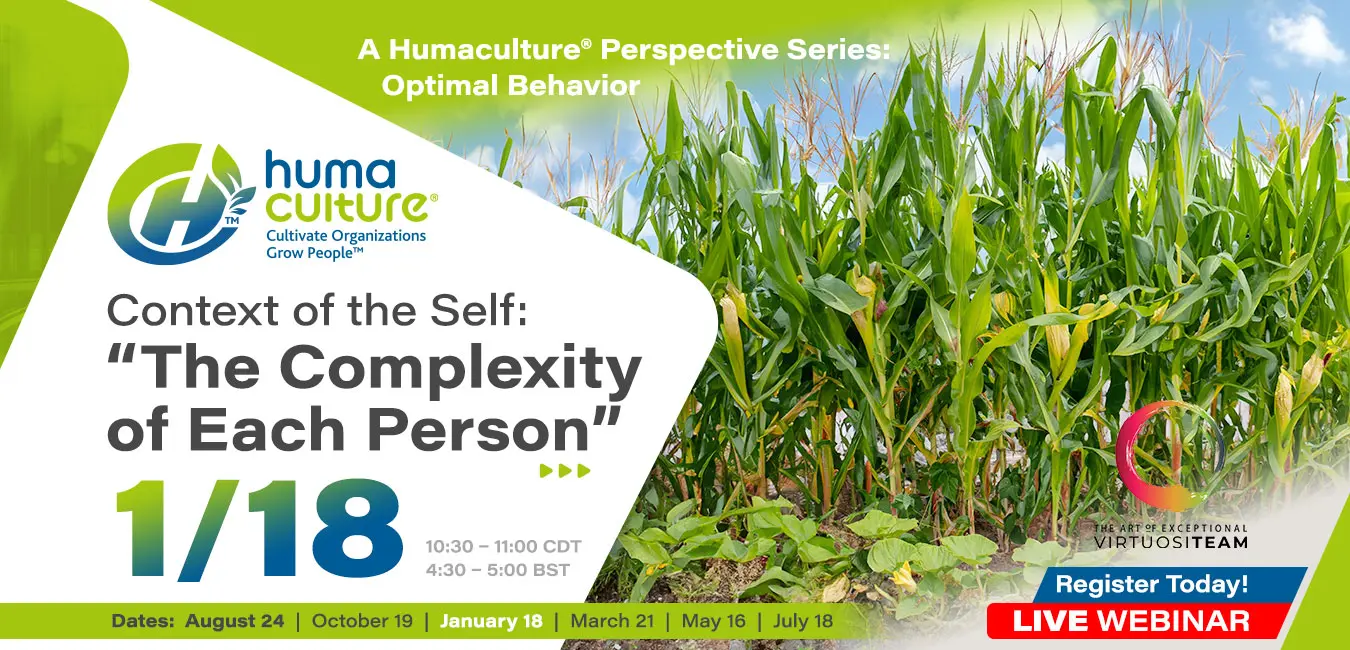
Join us on Thursday, January 18, 2024 from 10:30 to 11:00 CDT for the third webinar in Humaculture, Inc.’s “Optimal Behavior: Making Optimal Behavior the Natural Choice.” You will learn why the self can hamper performance and well-being and how to help People to grow capabilities, inspire motivation, overcome barriers, and resist temptations in order to lead to optimal behavior.
Presenters
- Steve Cyboran, ASA, MAAA, FCA, CEBS, actuary and strategy consultant
- Wes Rogers, Humaculturist® and strategy consultant
- Colin Bullen, ASA, behavior change actuary
- Hanlie van Wyk, behavior change consultant
Objective
In this third session in our series on optimal behavior, we explore how the Context of Self influences behavior. To be effective within the Organization, People need to know and manage themselves through their own narrative and understand the same for the People around them. Organizations fail to use narrative stories to connect People to the meaning of changes they are trying to make. Organizations shy away from giving People constructive feedback, yet People need feedback to Grow. Organizations fail to articulate the reason the Organization exists and how People connect with it. To inspire people to perform, Organizational purpose needs to be clear and create emotional attachment, driving motivation. Finally, Organizations associate fun as something that happens outside the workplace and having fun is regarded as unproductive. However, scientists have discovered that it takes approximately 400 repetitions to create a new synapse in the brain, unless it is done in play, in which case it only takes 10 to 20 repetitions.
“The measure of intelligence is the ability to change.” Albert Einstein
Context of Self to Promote Optimal Behavior Key Takeaways
Join us to learn:
- How ineffective organizations:
- Don’t understand how People change behavior
- Don’t Grow Capability and Confidence to change
- Don’t motivate and inspire change
- Don’t recognize how People inhibit sustained behavior change
- How effective organizations:
- Grow competence in change resilience
- Inspire and motivate
- Deploy change sustaining reinforcement tools
Available Support
We are available to support you in your strategy, design, compliance, financial, and monitoring needs. Our team includes business and human relations leaders, finance experts, actuaries, clinicians, behavioral health experts, pharmacy experts, and legal resources to guide you through the strategy and compliance process. Please contact us: [email protected].
Webinar Replay: Spaces Context: “Grow a Willow in a Desert? The importance of Spaces”
Watch a replay of the second webinar in Humaculture, Inc.’s “Optimal Behavior: Making Optimal Behavior the Natural Choice” to learn why spaces can hamper performance and well-being and how to design your spaces to lead to optimal behavior.
Presenters
- Steve Cyboran, ASA, MAAA, FCA, CEBS, actuary and strategy consultant
- Wes Rogers, Humaculturist® and strategy consultant
- Colin Bullen, ASA, behavior change actuary
- Hanlie van Wyk, behavior change consultant
Objective
In this second session in our series on optimal behavior, we explore how spaces influence behavior. The physical space in which you work can elicit mental and physical reactions that impact positively on performance, mental wellbeing and physical health. Today, physical configuration of buildings reflects a bias toward human energy conservation—and against physical activity, thereby contributing to sedentary behavior which has been linked to nearly all costly lifestyle diseases. In addition, the World Health Organization (WHO) estimates that 30% of new or remodeled office buildings show signs of Sick Building Syndrome (SBS) and that between 10% and 30% of the occupants of these buildings are affected by SBS, e.g. lethargy.
Research further indicates that your physical space can have a positive effect of up to 22% on a range of performance indicators, such as improved concentration, focus, collaboration, learning and cognitive control (working memory, inhibition, and cognitive flexibility). Furthermore, loyalty to an organization is increasingly determined by social and place attachment.
“We shape our buildings, and afterwards, our buildings shape us.” –Winston Churchill
Shaping Spaces to Promote Optimal Behavior Key Takeaways
Join us to learn:
- Why spaces do not support well-being and may lead to sickness
- Why spaces hamper performance
- Why spaces are built counter to tasks
- How effective spaces can be designed to:
- Support healthy behavior and choices
- Improve innovation and performance
- Support efficient task completion
Available Support
We are available to support you in your strategy, design, compliance, financial, and monitoring needs. Our team includes business and human relations leaders, finance experts, actuaries, clinicians, behavioral health experts, pharmacy experts, and legal resources to guide you through the strategy and compliance process. Please contact us: [email protected].
Watch
Watch the Optimal Behavior: Spaces Context: “Grow a Willow in a Desert? The importance of Spaces” via Rumble or YouTube.
Spaces Context: “Grow a Willow in a Desert? The importance of Spaces”
Join us on Thursday, October 19, from 10:30 to 11:00 CDT for the second webinar in Humaculture, Inc.’s “Optimal Behavior: Making Optimal Behavior the Natural Choice.” You will learn why spaces can hamper performance and well-being and how to design your spaces to lead to optimal behavior.
Presenters
- Steve Cyboran, ASA, MAAA, FCA, CEBS, actuary and strategy consultant
- Wes Rogers, Humaculturist® and strategy consultant
- Colin Bullen, ASA, behavior change actuary
- Hanlie van Wyk, behavior change consultant
Objective
In this second session in our series on optimal behavior, we explore how spaces influence behavior. The physical space in which you work can elicit mental and physical reactions that impact positively on performance, mental wellbeing and physical health. Today, physical configuration of buildings reflects a bias toward human energy conservation—and against physical activity, thereby contributing to sedentary behavior which has been linked to nearly all costly lifestyle diseases. In addition, the World Health Organization (WHO) estimates that 30% of new or remodeled office buildings show signs of Sick Building Syndrome (SBS) and that between 10% and 30% of the occupants of these buildings are affected by SBS, e.g. lethargy.
Research further indicates that your physical space can have a positive effect of up to 22% on a range of performance indicators, such as improved concentration, focus, collaboration, learning and cognitive control (working memory, inhibition, and cognitive flexibility). Furthermore, loyalty to an organization is increasingly determined by social and place attachment.
“We shape our buildings, and afterwards, our buildings shape us.” –Winston Churchill
Shaping Spaces to Promote Optimal Behavior Key Takeaways
Join us to learn:
- Why spaces do not support well-being and may lead to sickness
- Why spaces hamper performance
- Why spaces are built counter to tasks
- How effective spaces can be designed to:
- Support healthy behavior and choices
- Improve innovation and performance
- Support efficient task completion
Available Support
We are available to support you in your strategy, design, compliance, financial, and monitoring needs. Our team includes business and human relations leaders, finance experts, actuaries, clinicians, behavioral health experts, pharmacy experts, and legal resources to guide you through the strategy and compliance process. Please contact us: [email protected].
Webinar Replay: Creating the Conditions for Optimal Behavior
Watch a replay of the first webinar in Humaculture, Inc.’s “Optimal Behavior: Making Optimal Behavior the Natural Choice” to learn why organizations don’t effectively execute change and be introduced to some of the concepts that facilitate optimal behaviors to support a high-performing culture.
Presenters
- Steve Cyboran, ASA, MAAA, FCA, CEBS, actuary and strategy consultant
- Wes Rogers, Humaculturist® and strategy consultant
- Colin Bullen, ASA, behavior change actuary
- Hanlie van Wyk, behavior change consultant
Objective
This is the introductory webinar in our new series on optimal behavior. We explore why people have difficulty in achieving and sustaining change, the difference between short term changes in behavior and long term change through habits, what it takes to achieve optimal behavior in a population, and how to use influence to create a high-performing culture.
Creating the Conditions for Optimal Behavior Key Takeaways
During this session, participants will learn that:
- Why people find it hard to behave optimally
- Why people behave inconsistently
- Why organizations fail to execute change effectively
- How effective organizations:
- Set the contexts to influence behavior
- Understand the powers that influence behavior
- Use influence to create a high-performing culture
Available Support
We are available to support you in your strategy, design, compliance, financial, and monitoring needs. Our team includes business and human relations leaders, finance experts, actuaries, clinicians, behavioral health experts, pharmacy experts, and legal resources to guide you through the strategy and compliance process. Please contact us: [email protected].
Watch
Watch the Career Planning: Effective Pruning Bears Fruit: Manager Development Webinar Replay via Rumble or YouTube.
Introduction: Creating the Conditions for Optimal Behavior
Join us on Thursday, August 24, from 10:30 to 11:00 CDT for the first webinar in Humaculture, Inc.’s “Optimal Behavior: Making Optimal Behavior the Natural Choice.” You will learn why organizations don’t effectively execute change and be introduced to some of the concepts that facilitate optimal behaviors to support a high-performing culture.
Presenters
- Steve Cyboran, ASA, MAAA, FCA, CEBS, actuary and strategy consultant
- Wes Rogers, Humaculturist® and strategy consultant
- Colin Bullen, ASA, behavior change actuary
- Hanlie van Wyk, behavior change consultant
Objective
This is the introductory webinar in our new series on optimal behavior. We will explore why people have difficulty in achieving and sustaining change, the difference between short term changes in behavior and long term change though habits, what it takes to achieve optimal behavior in a population, and how to use influence to create a high-performing culture.
Creating the Conditions for Optimal Behavior Key Takeaways
During this session, participants will learn that:
- Why people find it hard to behave optimally
- Why people behave inconsistently
- Why organizations fail to execute change effectively
- How effective organizations:
- Set the contexts to influence behavior
- Understand the powers that influence behavior
- Use influence to create a high-performing culture
Optimal Behavior: Making Optimal Behavior the Natural Choice
Please join Humaculture, Inc. and Virtuositeam for our Humaculture® Perspective Series on Optimal Behavior. This series will focus on how to create the conditions to Make Optimal Behavior the Natural Choice.
Overview
In this webinar series, we explore ways organizations can incorporate research-based, practical approaches to nurture and support optimal behaviors. Optimal behaviors are those that are the most beneficial to the individual as well as the organization.
Horticulturists consider the impact of the conditions in which plants are grown (e.g., climate, soil structure, space and fertility, arrangement, companion planting). Growth and productivity improve when the context of each dimension is appropriately addressed, and the responses of each plant to these conditions are clearly understood and applied. Expertise from fields like botany and soil sciences provide the successful horticulturist with the information to do their jobs well.
Similarly, Humaculturists consider the Seven Dimensions of Humaculture® to employ knowledge solidly “rooted” in science for the best results. Behavioral Research Applied Technology Laboratory (BRATLAB), Virtuositeam’s research arm, set out to answer some crucial questions related to understanding changes in behavior and habit creation:
- Which habits really matter, and to what degree, to the three biggest hidden drivers of sustained performance at work, human health, happiness, and security?
- How do we support people to practice these habits in a way that they experience as easy and natural, and that leaves them feeling highly engaged with their employer?
Four Powers Model of Change
The result: the Four Powers Model of Change. This model helps organizations create a thriving culture by leveraging this key distinction: how people THINK they behave and make decisions, versus how they ACTUALLY behave and make decisions. Four Powers is based on behavioral theories and validated research from a variety of leading thinkers, behavioral research laboratories, and BRATLAB’s own extensive field testing. BRATLAB looked across industries to find the influence techniques that have been successfully used to shape employee and customer behavior for years.
The topics for the upcoming series will include:
| August 24, 2023 – 10:30-11:00 CDT | Introduction: “Creating the Conditions for Optimal Behavior” |
| October 19, 2023 – 10:30-11:00 CDT | Spaces Context: “Grow a Willow in a Desert? The importance of Spaces” |
| January 18, 2023 – 10:30-11:00 CDT | Context of the Self: “The Complexity of Each Person” |
| March 21, 2024 – 10:30-11:00 CDT | Systems Context: “The Systems that Govern Behavior” |
| May 16, 2024 – 10:30-11:00 CDT | Social Context: “How People Influence Each Other” |
| July 18, 2024 – 10:30-11:00 CDT | Harvest Time: “Reaping the Fruit of Optimal Behaviors” |
Prior Series
- Hidden Opportunities, A Strategic Compliance Series
- People Development: A Humaculture® Perspective Series
Available Support
We are available to support you in your strategy, design, compliance, financial, and monitoring needs. Our team includes experts in organization design, actuarial science, clinical, and legal can guide the process to achieve optimal behavior. Please contact us.
Weathering the Storm: Is Your Organizational “Soil” Healthy Enough to Weather Both Floods and Droughts?

During these unprecedented times with businesses having been shut down due to an outside order by the government in response to COVID-19, many sectors of the economy, labeled as “non-essential,” were ordered to close business for a period. Organizations that are highly leveraged (a significant portion of the revenue is used to pay debt) or in lower margin businesses face an even greater challenge. Organizations need to figure out how to weather the storm. These options may include reduction in force to rolling furloughs, and potentially reorganizing through bankruptcy. What is the right decision for your organization?
If we think about an organization like the soil, the employees like plants growing in the organization, and the fruit they bear as the value or profit of the organization, then horticulture can provide a good analogy from which to view options for addressing the current situation. From a horticultural perspective, the current “storm” is like a drought. The first thing a horticulturist might do, for example, when faced with a drought is add mulch and preserve soil moisture, not jerk plants out of the garden. As another example, during an unexpected late freeze, it may become necessary to cover plants to enable them to maintain their heat.
“It is not nice to garden anywhere. Everywhere there are violent winds, startling once-per-five-centuries floods, unprecedented droughts, record-setting freezes, abusive and blasting heats never known before. There is no place, no garden, where these terrible things do not drive gardeners mad.” Henry Mitchell, author of the Essential Earthman
When weighing options to reduce costs and capacity such as layoffs, furloughs, rolling unpaid time off, treatment of unused PTO, leadership needs to weigh several considerations. For example,
Culture – One of the most important considerations may be how the organization wants to come out of this trying time. The approach may vary depending on the type of culture currently in place. For example:
- Strong, Productive Culture and Balance Sheet – If an organization has a strong, productive culture, with good talent and is financially strong enough to weather the current challenges (e.g., well prepared, fertile soil, that is more resilient), layoffs can be one of the most detrimental actions an organization can take to the long-term health of the organization and its people. There will be a drain on talent that may later be needed to support a strong recovery for the business, and that talent may wind up joining, or starting, competitors and taking a certain portion of knowledge with them. Layoffs made too hastily, where the remaining jobs aren’t redesigned to accommodate the reduction in staff and pick up the essential tasks of those leaving, may result in the need to rehire many of those positions. Then the organization assumes the cost of the layoff, and training of the new hires for the same positions, without any long-term value gain. In addition to considering the impact of the loss of talent from layoffs, the organization should budget for an increase in health, absence, and disability costs. We have seen 5% to 10% unanticipated increase in these costs depending upon the size and nature of the restructuring. The implications of a layoff may have long term impact that may make the long-term cost not worth the short-term gain. Other considerations may achieve the same goal while preserving the culture and health of the organization and its people.
- Culture is In Need of a Refresh – On the other hand, if there has been a need to rethink the culture and business structure (remove plants not well-suited for the garden, transplant some to different soil, and prune existing plants to shape them to be more productive), then it may make sense to consider some form of restructuring of the leadership and/or workforce. This can present a great opportunity to accomplish the organizational change that has been desperately needed but deferred. The type and nature of the restructuring may depend upon the suitability of the employees to achieve the business strategy. Organizational leaders should consider aspects of both cultural alignment and cultural health. A few examples (certainly not comprehensive) to consider may include:
- Working Retired – If there is a segment of the workforce at normal retirement age that may still be employed, but lack the energy and commitment necessary to take the organization where it needs to go. Then the organization may get more energy and innovation from a younger, less costly resource. In this case, an early retirement window may make sense. One client has a location where 70% of the workforce is retirement eligible and has the highest labor costs, but the employees are unprepared and afraid to retire. An early retirement window may be beneficial to those eligible for retirement and the organization.
- Strategically Misaligned – If there are certain businesses or shared service segments that may not be a good strategic fit (not directly driving the strategic priorities of the organization), then the organization may consider selling off, outsourcing, or co-sourcing those functions. For example, if your business is higher education, an outsourced food services contract affords greater flexibility during periods where the campus is shut down.
- Re-alignment – If there are opportunities to automate, streamline, or eliminate positions, then the organization may need to restructure. If the organization chooses this route, it is important that jobs are redesigned to ensure important functions don’t fall through the cracks, that you have the right talent in those positions, which may involve “transplanting” employees to other areas of the organization, and retraining or hiring different talent. Some of our clients have worked with a management consulting firm to evaluate staffing ratios to determine how many people should be appropriate. Following those recommendations, the client reduces staffing levels as indicated, but without redesigning the remaining jobs, they must often rehire those positions because critical work isn’t getting done.
Temporary Nature – Organizations will also need to consider if, and to what extent, this challenge will be a short term. If this will only be a temporary set-back and demand is simply deferred (e.g., delayed purchases such as iPhones, or elective procedures), or even if business will rebound to similar levels of activity from prior to the current downturn, then the organization may want to consider more of a shared responsibility approach with rolling unpaid time off or even furloughs. With the right messaging, the organization may be able to enhance its relationship with employees, letting them know the organization doesn’t want to let any of its teammates go during these challenging times, so we all need to consider ways to save money and share in the sacrifice. However, with 40% of the workforce living paycheck to paycheck[1], they may need to consider the potential impact on the financial well-being of the workforce if they are asked to work less (for example, 20% reduction in hours, and a corresponding 20% pay cut).
“My heightened awareness of stewardship to those within my span of care gave me a clear sense of purpose and clarity through which to view the situation. I thought to myself: We’re a family at Barry-Wehmiller so we need to act like one. What would a responsible family do in this crisis? A loving family would share the burden. Rather than watching a few of our colleagues face devastation, we decided that our reaction would be one of shared sacrifice.” Bob Chapman, CEO of Barry-Wehmiller
Other Cost Saving Opportunities – There are a number of dials in the various reward programs that can be considered. For example, time off programs can be leveraged to save cost and moderate the capacity of the workforce. The time off policies, and other state and local regulations, often drive a number of cost considerations, such as:
- Do you pay out unused PTO upon termination or at the end of the year?
- How does time accrue (e.g., front-load, weekly accruals)?
- To what level and extent should time accrue, or temporarily stop accruing during an economic downturn?
- What is the right level and balance between scheduled time off (PTO/vacation/holidays) vs. unscheduled time off (sick leave, disability, emergency)?
While there may be pressure to make rash decisions to lay people off for quick cost savings to preserve the profitability of the organization, take a step back and consider alternatives that may be similarly impactful, but preserve the “tilth” of the organization for the future.
Authors:
Steve Cyboran, ASA, MAAA, FCA, CEBS, Chief Behavioral Officer, Consulting Actuary for Humaculture, Inc. Over the past 30 years, Steve has worked extensively with leading corporations, higher education institutions, and health systems across the country to articulate a vision for a healthy and effective workplace culture, develop a total rewards strategy to support that vision and brings deep benefits expertise with a behavioral approach and sound analytics to achieve and measure the desired outcomes. Contact Steve at [email protected].
Wes Rogers, Chief Guidance Officer for Humaculture, Inc. Wes has almost 35 years’ experience in consulting and senior management positions with a variety of organizations, facilitating groups of people with diverse perspectives and objectives to coalesce around a singular vision and marshal resources to achieve the vision. This experience provides exceptional insights into how organizations operate and succeed. Contact Wes at [email protected].
About Humaculture, Inc.
Humaculture, Inc. transforms organizations, the relationship with their people, and how they think about their people. Humaculture® is a philosophy of, and systematic approach to, creating profitable, aligned, and healthy organizations conceptualized as “soil” in which people can thrive. By creating the right culture, the organization naturally attracts, retains, sustains, grows, and transitions people who enable the business to thrive. More information can be found at: Humaculture.com.
[1]Research from the Federal Reserve found that 4 in 10 Americans couldn’t afford a $400 emergency, and 22% say they expect to forgo payments on some of their bills (https://www.marketwatch.com/story/half-of-americans-are-just-one-paycheck-away-from-financial-disaster-2019-05-16).


