
Category: Organizational Development
Introduction: Creating the Conditions for Optimal Behavior
Join us on Thursday, August 24, from 10:30 to 11:00 CDT for the first webinar in Humaculture, Inc.’s “Optimal Behavior: Making Optimal Behavior the Natural Choice.” You will learn why organizations don’t effectively execute change and be introduced to some of the concepts that facilitate optimal behaviors to support a high-performing culture.
Presenters
- Steve Cyboran, ASA, MAAA, FCA, CEBS, actuary and strategy consultant
- Wes Rogers, Humaculturist® and strategy consultant
- Colin Bullen, ASA, behavior change actuary
- Hanlie van Wyk, behavior change consultant
Objective
This is the introductory webinar in our new series on optimal behavior. We will explore why people have difficulty in achieving and sustaining change, the difference between short term changes in behavior and long term change though habits, what it takes to achieve optimal behavior in a population, and how to use influence to create a high-performing culture.
Creating the Conditions for Optimal Behavior Key Takeaways
During this session, participants will learn that:
- Why people find it hard to behave optimally
- Why people behave inconsistently
- Why organizations fail to execute change effectively
- How effective organizations:
- Set the contexts to influence behavior
- Understand the powers that influence behavior
- Use influence to create a high-performing culture
Optimal Behavior: Making Optimal Behavior the Natural Choice
Please join Humaculture, Inc. and Virtuositeam for our Humaculture® Perspective Series on Optimal Behavior. This series will focus on how to create the conditions to Make Optimal Behavior the Natural Choice.
Overview
In this webinar series, we explore ways organizations can incorporate research-based, practical approaches to nurture and support optimal behaviors. Optimal behaviors are those that are the most beneficial to the individual as well as the organization.
Horticulturists consider the impact of the conditions in which plants are grown (e.g., climate, soil structure, space and fertility, arrangement, companion planting). Growth and productivity improve when the context of each dimension is appropriately addressed, and the responses of each plant to these conditions are clearly understood and applied. Expertise from fields like botany and soil sciences provide the successful horticulturist with the information to do their jobs well.
Similarly, Humaculturists consider the Seven Dimensions of Humaculture® to employ knowledge solidly “rooted” in science for the best results. Behavioral Research Applied Technology Laboratory (BRATLAB), Virtuositeam’s research arm, set out to answer some crucial questions related to understanding changes in behavior and habit creation:
- Which habits really matter, and to what degree, to the three biggest hidden drivers of sustained performance at work, human health, happiness, and security?
- How do we support people to practice these habits in a way that they experience as easy and natural, and that leaves them feeling highly engaged with their employer?
Four Powers Model of Change
The result: the Four Powers Model of Change. This model helps organizations create a thriving culture by leveraging this key distinction: how people THINK they behave and make decisions, versus how they ACTUALLY behave and make decisions. Four Powers is based on behavioral theories and validated research from a variety of leading thinkers, behavioral research laboratories, and BRATLAB’s own extensive field testing. BRATLAB looked across industries to find the influence techniques that have been successfully used to shape employee and customer behavior for years.
The topics for the upcoming series will include:
| August 24, 2023 – 10:30-11:00 CDT | Introduction: “Creating the Conditions for Optimal Behavior” |
| October 19, 2023 – 10:30-11:00 CDT | Spaces Context: “Grow a Willow in a Desert? The importance of Spaces” |
| January 18, 2023 – 10:30-11:00 CDT | Context of the Self: “The Complexity of Each Person” |
| March 21, 2024 – 10:30-11:00 CDT | Systems Context: “The Systems that Govern Behavior” |
| May 16, 2024 – 10:30-11:00 CDT | Social Context: “How People Influence Each Other” |
| July 18, 2024 – 10:30-11:00 CDT | Harvest Time: “Reaping the Fruit of Optimal Behaviors” |
Prior Series
- Hidden Opportunities, A Strategic Compliance Series
- People Development: A Humaculture® Perspective Series
Available Support
We are available to support you in your strategy, design, compliance, financial, and monitoring needs. Our team includes experts in organization design, actuarial science, clinical, and legal can guide the process to achieve optimal behavior. Please contact us.
Webinar Replay: Effective Pruning Bears Fruit: Leadership Development
Watch a replay of the fifth webinar in Humaculture, Inc.’s “People Development: A Humaculture® Perspective Series” to learn how to conduct Career Planning to support leadership development, and why “Effective Pruning Bears Fruit” by building leadership capabilities.
Presenters
- Steve Cyboran, ASA, MAAA, FCA, CEBS, actuary and strategy consultant
- Wes Rogers, Humaculturist® and strategy consultant
- Christi Green, RN, MS, PHR, strategy and people consultant
Objective
We’ve talked about how to develop managers to lead to growth and new directions as opposed to staying rooted in the current problems. Now this webinar focuses on how to develop leaders to advance strategy, focus on people, and inspire performance. This results in leadership cultivating the organizational “soil” which leads to real, practical changes that advance the business.
Career Planning: Leadership Development Key Takeaways
During this session, participants will learn that:
- Leaders fail to make decisions
- Leadership vacuums create confusion and a toxic environment
- Leaders who lack a broad perspective undermine operations
- For effective leadership development organizations must:
- Understand effective leadership qualities
- Build and cultivate the right organizational “soil”
- Develop leaders who have good intuition and decision-making skills
- Ensure well-rounded leadership team with appropriate autonomy
- Nurture and develop for intended purposes
Available Support
We are available to support you in your strategy, design, compliance, financial, and monitoring needs. Our team includes business and human relations leaders, finance experts, actuaries, clinicians, behavioral health experts, pharmacy experts, and legal resources to guide you through the strategy and compliance process. Please contact us: [email protected].
Watch
Watch the Career Planning: Effective Pruning Bears Fruit: Manager Development Webinar Replay via Rumble or YouTube.
Webinar Replay: Effective Pruning Bears Fruit: Manager Development
Watch a replay of the fourth webinar in Humaculture, Inc.’s “People Development: A Humaculture® Perspective Series” to learn how to conduct Career Planning to support manager development, and why “Effective Pruning Bears Fruit” by building manager capabilities.
Presenters
- Steve Cyboran, ASA, MAAA, FCA, CEBS, actuary and strategy consultant
- Wes Rogers, Humaculturist® and strategy consultant
- Christi Green, RN, MS, PHR, strategy and people consultant
Objective
We’ve talked about how to “Effectively Prune” to activate and inspire our workplace AND workforce to further grow and develop employees. Now this webinar focuses on how to develop managers to facilitate growth instead of control, to focus on people in addition to results, and to be vision driven instead of a problem solver. This leads to growth and new directions as opposed to staying rooted in the current problems.
Career Planning: Manager Development Key Takeaways
During this session, participants will learn that:
- Organizations fall into the “star” employee syndrome
- Organizations don’t think from a people development perspective
- Culture of Control creates a toxic environment
- For effective manager development organizations must:
- Promote intentionally to fulfill vision, mission, values
- Effectively identify manager qualities/potential
- Develop and deploy learning and growth opportunities
- Shift from Culture of Control to Culture of Growth
- Prepare for appropriate transitions
Available Support
We are available to support you in your strategy, design, compliance, financial, and monitoring needs. Our team includes business and human relations leaders, finance experts, actuaries, clinicians, behavioral health experts, pharmacy experts, and legal resources to guide you through the strategy and compliance process. Please contact us: [email protected].
Watch
Watch the Career Planning: Effective Pruning Bears Fruit: Manager Development Webinar Replay via Rumble or YouTube.
Webinar Replay: Effective Pruning Bears Fruit: Employee Development
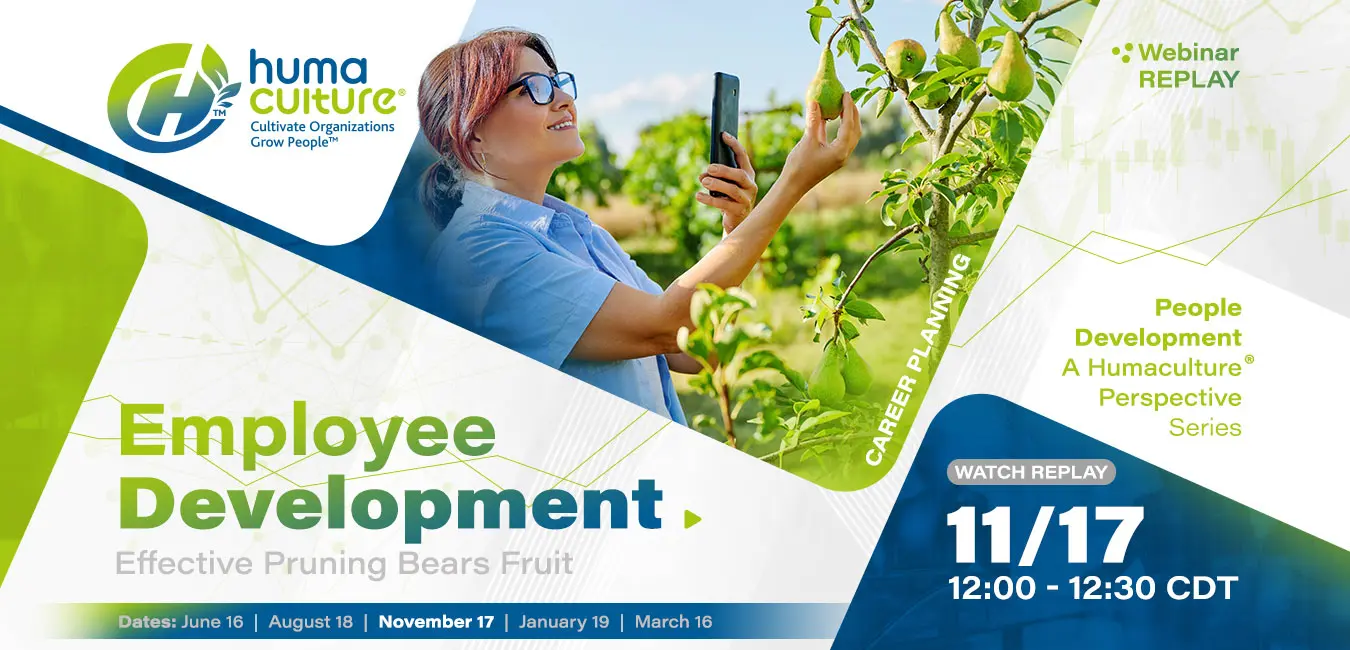
Watch a replay of the third webinar in Humaculture, Inc.’s “People Development: A Humaculture® Perspective Series” to learn how to conduct Career Planning to support employee development, and why “Effective Pruning Bears Fruit” by building employee capabilities.
Presenters
- Steve Cyboran, ASA, MAAA, FCA, CEBS, actuary and strategy consultant
- Wes Rogers, Humaculturist® and strategy consultant
- Christi Green, RN, MS, PHR, strategy and people consultant
Employee Development Objective
We’ve talked about how to “Walk the Garden” to assess employees as well as help them develop capabilities to align with the organization’s vision, mission, and values. Now this webinar focuses on how to activate and inspire our workplace AND workforce to further grow and develop employees. Research is abundantly clear that engaged employees help organizations succeed and bear fruit. There is no silver bullet to increase retention/reduce turnover. However, we do believe that investing in the organizational soil and the culture to nurture and support people will bear the fruits of success!
Career Planning: Employee Development Key Takeaways
During this session, participants will learn that:
- Organizations sometimes fall into the “warm body syndrome” trap
- Unhealthy/misaligned cultures disrupt employee development efforts
- Career planning tends to only occur only for a select few
- For effective employee development organizations must:
- Hire and develop intentionally to fulfill the vision, mission, values
- “Prune” to focus growth as well as direct energy and effort
- “Trellis and irrigate” to support desired growth
- Prepare for appropriate transitions
Available Support
We are available to support you in your strategy, design, compliance, financial, and monitoring needs. Our team includes business and human relations leaders, finance experts, actuaries, clinicians, behavioral health experts, pharmacy experts, and legal resources to guide you through the strategy and compliance process. Please contact us: [email protected].
Watch
Watch the Career Planning: Effective Pruning Bears Fruit: Employee Development Webinar Replay below, or via Rumble or YouTube.
Webinar Replay: Pruning the Vines – Capabilities: Prune to Encourage Growth
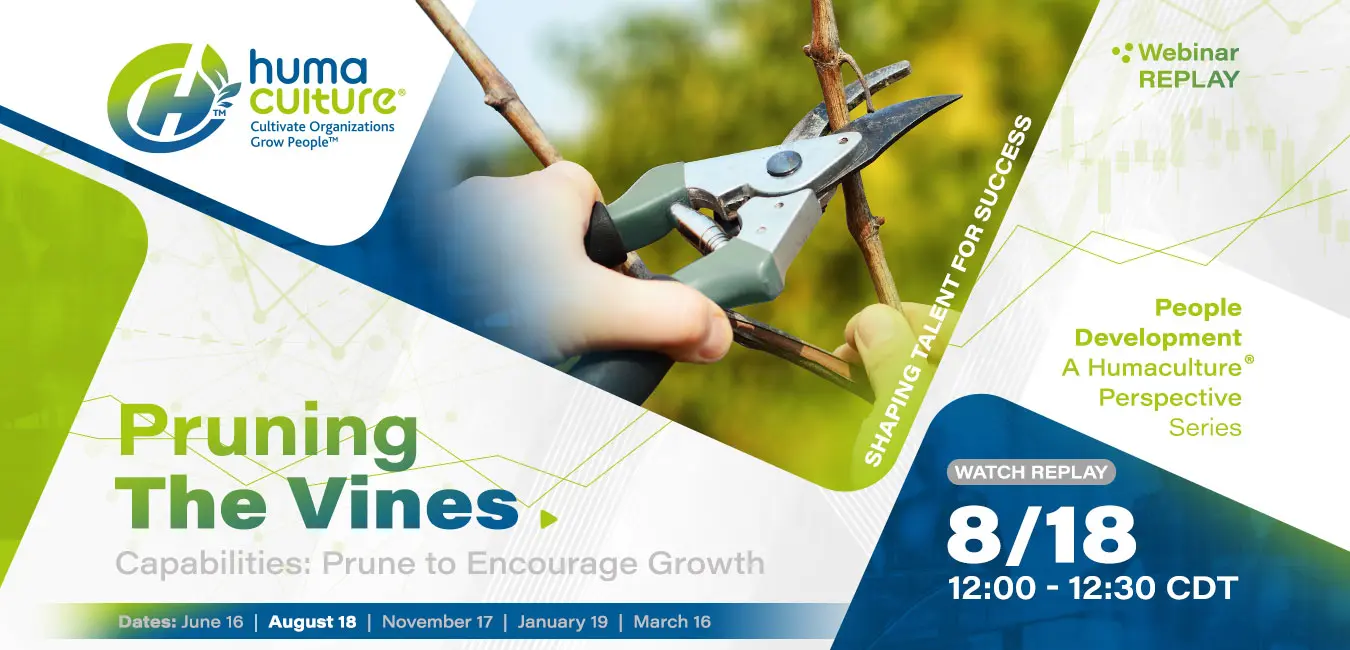
Watch a replay of the second webinar in Humaculture, Inc.’s “People Development: A Humaculture® Perspective Series”, to learn how to shape talent for success by “Pruning the Vines,” using capabilities to prune to encourage growth so employees to fulfill their potential and maximize alignment and productivity.
Presenters
- Steve Cyboran, ASA, MAAA, FCA, CEBS, actuary and strategy consultant
- Wes Rogers, Humaculturist® and strategy consultant
- Christi Green, RN, MS, PHR, strategy and people consultant
Prune to Encourage Growth Objective
This webinar explores ways organizations can “Prune to Encourage Growth” to shape talent for the future. Capabilities can be used to help organizations select the best plants, determine how best to organize them in the garden, identify strengths and weaknesses, prune away distractions (weak branches) to encourage growth and fruit production.
Key Takeaways
During this session, participants will learn that:
- Competencies tend to be just a checklist of skills to manage
- People that focus on everything may not be very good at anything
- Highly skilled employees may not thrive in management or leadership
- Effective people development:
- Is rooted in a clear understanding of organizational vision
- Facilitates growth, supports optimal organizational (garden) design
- Assesses skills and needs to support strategic priorities
- Explores the employee’s interests, abilities, and desires
- Identifies potential for transitions, management, or leadership
- Applies principles that work
Available Support
We are available to support you in your strategy, design, compliance, financial, and monitoring needs. Our team includes business and human relations leaders, finance experts, actuaries, clinicians, behavioral health experts, pharmacy experts, and legal resources to guide you through the strategy and compliance process. Please contact us: [email protected].
Watch
Watch the Shaping Talent for Success: Pruning the Vines – Capabilities: Prune to Encourage Growth Webinar Replay below, or via Rumble or YouTube.
Webinar Replay: Walking the Garden – Shift from Managing to Facilitating Growth
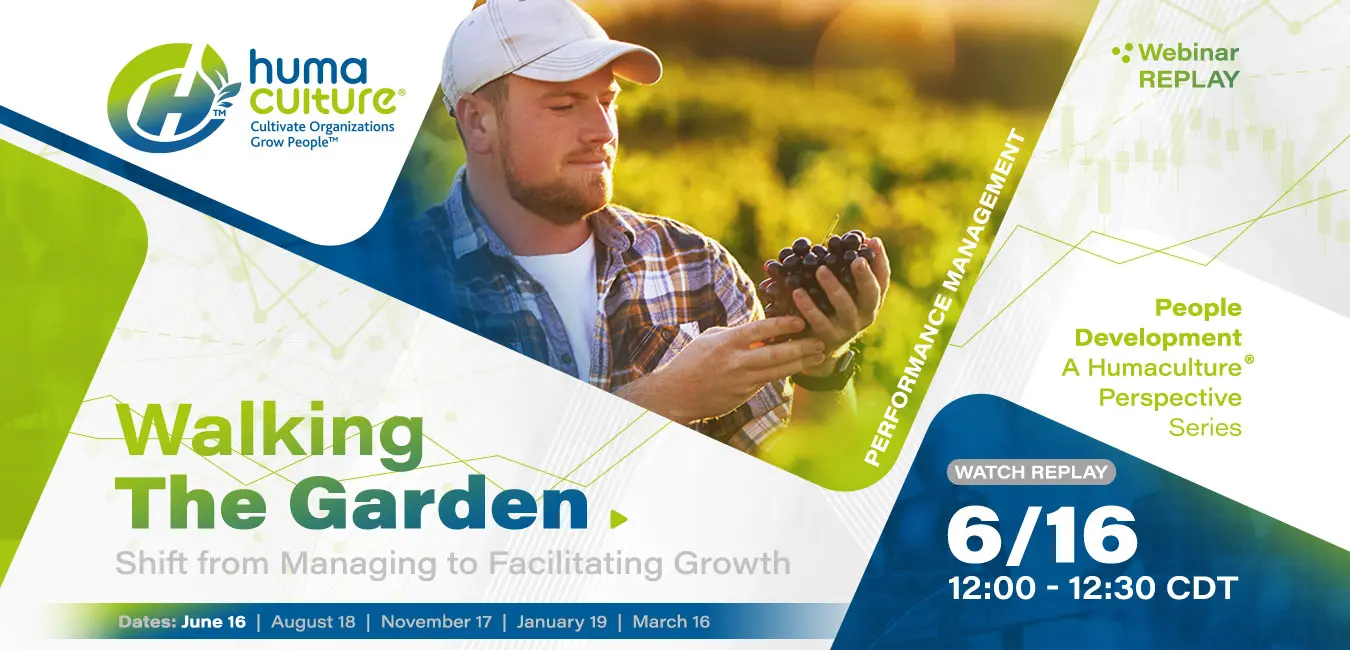
Watch a replay of the first webinar in Humaculture, Inc.’s “People Development: A Humaculture® Perspective Series”, which focuses on how to “Walk the Garden” to build employee relationships, enhance culture, and improve productivity. We discuss transforming your performance management process into one that focuses on facilitating growth and productivity.
Presenters
- Steve Cyboran, ASA, MAAA, FCA, CEBS, actuary and strategy consultant
- Wes Rogers, Humaculturist® and strategy consultant
- Christi Green, RN, MS, PHR, strategy and people consultant
Objective
This webinar explores ways organizations can shift traditional performance management from the dreaded once-a-year process that is focused on past performance into an on-going discussion. “Walking the Garden” builds strong relationships, keeps people aligned with the culture, helps identify issues early that may inhibit productivity, facilitates growth, prepares your next generation of leaders, and identifies opportunities for transition. This requires proper job design to ensure employees are “planted in fertile soil.”
Key Takeaways
During this session, participants will explore:
- The pitfalls of trying to “manage performance”
- Why traditional “performance management” is a dreaded process, often detrimental to employee relationships, culture, and productivity
- How manager job design and span of control may limit effectiveness
- How effective people development will:
- Shift from “managing performance” to facilitating growth
- Help managers and leaders learn to “walk the garden”
- Lead to better alignment between employees’ personal/professional goals and the organization’s strategic priorities
Available Support
We are available to support you in your strategy, design, compliance, financial, and monitoring needs. Our team includes business and human relations leaders, finance experts, actuaries, clinicians, behavioral health experts, pharmacy experts, and legal resources to guide you through the strategy and compliance process. Please contact us: [email protected].
Watch
Watch the Performance Management: Walking the Garden – Shift from Managing to Facilitating Growth Webinar Replay below, or via Rumble or YouTube.
People Development: A Humaculture® Perspective Series
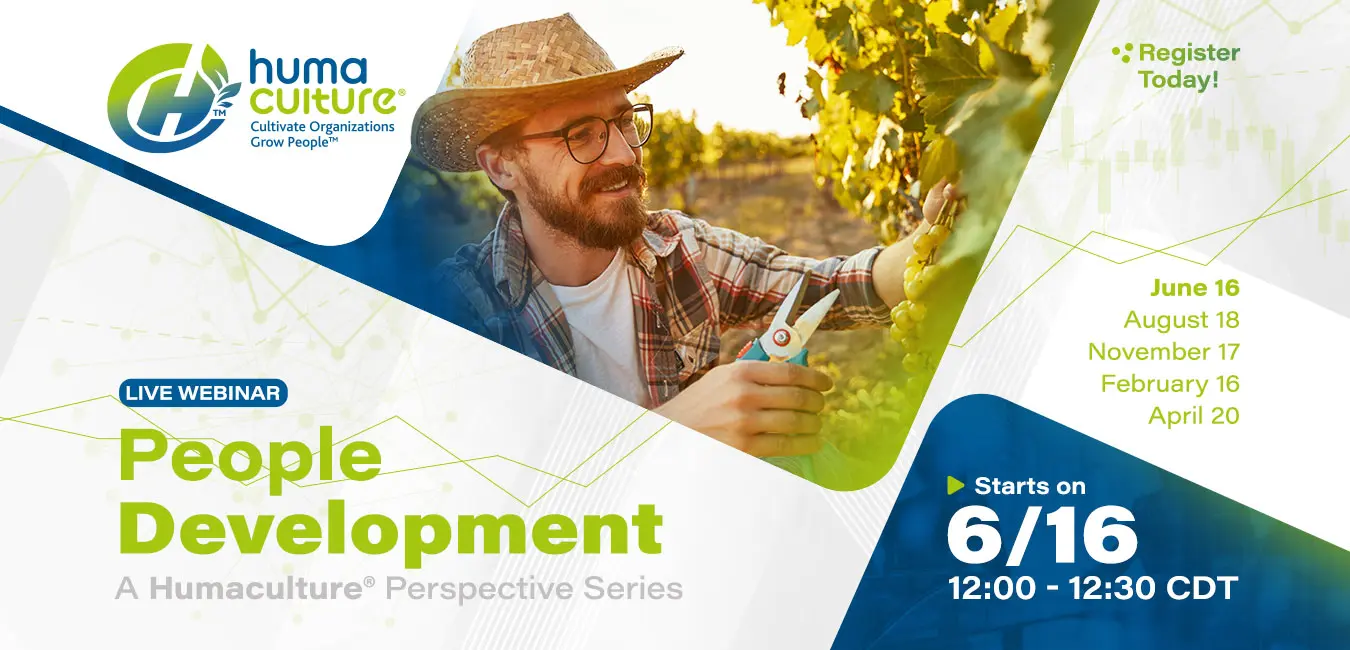
Please join us on the third Thursday of the month over the next six months for our upcoming People Development series. This series will focus on how to shape talent for success by “pruning the vines” as necessary. We will cover people development from the Humaculture® perspective.
In this webinar series, we explore ways organizations can rethink the traditional performance management and people development processes to make them more meaningful, impactful, and aligned with the organizational vision and strategy – focusing employees and leaders on what is truly important.
Successful horticulturists recognize the overwhelmingly positive impact of pruning. Pruning is the process of removing branches that:
- Are not supporting the desired shape of the plant the horticulturist seeks,
- Take energy from the plant without maximizing productivity,
- Shade or otherwise interfere with the productivity of the other branches.
Effective pruning allows the plant to focus its energies in the most effective and productive areas. People, like plants, often expend energy and time in areas that distract them from achieving their highest and greatest purpose and contributions. In any organization, it is important to help employees remove or overcome the impediments that hold them back, and focus on the areas and interests that will really help them achieve their goals, as well as the strategic priorities of the organization. This series highlights several ways organizations can be innovative and more effective than traditional “performance management.”
The topics for the upcoming series include:
| Performance Management: Walking the Garden | |
| June 16, 2022 – 12:00-12:30 CDT | The shift from Managing to Facilitating Growth |
| Shaping Talent for Success: Pruning the Vines | |
| August 18, 2022 – 12:00-12:30 CDT | Capabilities: Prune to Encourage Growth |
| Career Planning: Effective Pruning Bears Fruit | |
| November 17, 2022 – 12:00-12:30 CDT | Employee Development |
| February 16, 2023 – 12:00-12:30 CDT | Manager Development |
| April 20, 2023 – 12:00-12:30 CDT | Leadership Development |
To view our prior Strategic Compliance series on the Hidden Opportunities within the CAA and Transparency Rules, click here.
Available Support
We are available to support you in your strategy, design, compliance, financial, and monitoring needs. To that end, our team of consultants, including actuaries, clinicians, behavioral health, pharmacy, and legal resources are available to guide you through the compliance process. Please contact us.
Leadership & Tomatoes: 3 Business Principles from My Garden
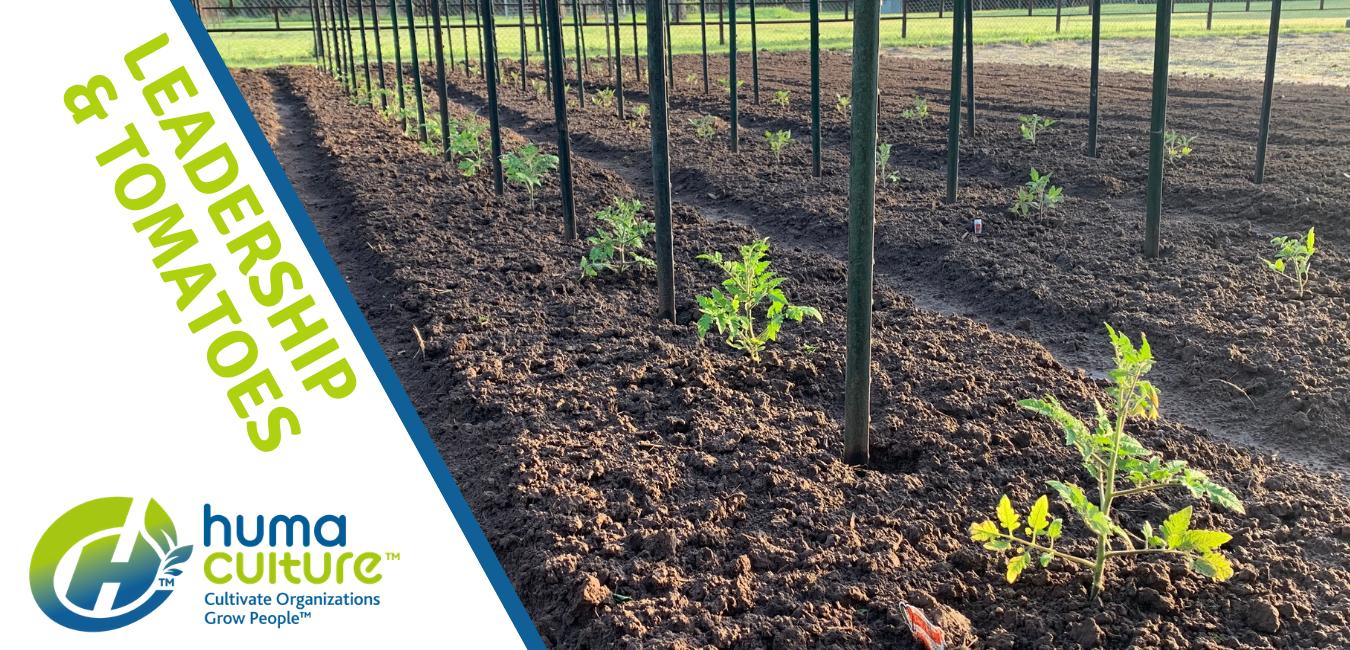
About 1 in 3 people aspire to a leadership role in business.1 About 1 in 3 people grow a kitchen garden.2 The motivation is the same with both demographics. What is it? The tomatoes, of course. Business success. The harvest.
In turn, successful businesses and successful gardens also have something in common: the people who are rooting (pun intended) for it all to be a thriving ecosystem, resulting in a bountiful harvest for everyone.
Over the years, I have observed that many horticulture principles can provide insights and understanding to help those in leadership build more successful organizations.
Leadership Principle #1 — First build the soil.
Without first building healthy soil, gardening is unlikely to be successful. Well-prepared, deep garden soil gives plants the best opportunity to grow a strong root system.

In my garden, I till the soil each spring while the temperatures are still dipping below freezing. I add compost, fall leaves, and grass clippings to add nutrients and texture to the soil. I add alkaline wood ash from winter fires to maintain the soil’s pH balance, since I know my iron-laden well water tends to acidify the soil over time.
Well-prepared soil ensures the plants have the nutrients they need. Good soil also maintains a more consistent temperature, and it allows excess water to drain away faster, retaining only a healthy amount of moisture and retaining it longer.
If we think of businesses and organizations as the soil in which we grow and earn our living, we can easily begin to see parallels between a garden and an organization. An organization that is well prepared has sufficient capitalization, delivers products and services consistent with its vision and mission, is conducive to employee health and well-being, has reserves to weather economic storms, etc.
Most new businesses fail because those who form them are focused primarily on the success they hope to achieve (i.e. harvesting a bumper crop of metaphorical tomatoes), rather than first focusing on the soil preparation that will be critical to that success.
Leadership Principle #2 — Support the plants as they grow.
Once the soil is prepared, the hardest work is done. I have created a nutrient-rich, foundational environment the tomato plants can send deep roots down into and draw resources from to thrive.

In addition to building the soil, I also have further resources to ensure the tomatoes’ success. I supply supports for the plants as they grow taller and bend under the weight of their fruit. I provide irrigation, giving plants the extra water they need in the dry summertime. I walk through the garden almost every day to identify stressors affecting the plants so I can intervene with extra support if necessary.
Employees—even those in the best-prepared organizational soils—will experience negative stressors and challenges from time to time. Distressed tomato plants, just like people experiencing excessive stress, will never be as productive as they would be if they were healthy, and the quality of what they produce will likely be lower as well. Like a horticulturist walking through the garden, a person in a leadership position needs to be able to recognize when something is preventing the employees within their span of care from fully thriving.
Perhaps the employee is not well-matched to the job; they might benefit from transplanting to another area of the organization. Perhaps some benefits, compensation, recognition and performance management programs, advancement pathways, etc. are not properly designed to align with the organizational vision or mission; more beneficial behavioral designs could be put in place instead. Perhaps there are organizational climate challenges; the team might need special support during especially trying times to overcome the difficulties and thrive.
Often, the problem lies not with the employee, but with the organization and whether it optimizes the availability of its resources so employees can effectively leverage them and thrive.
Leadership Principle #3 — Plants don’t exist for soil; soil exists for plants.
The primary focus of a successful garden is never actually the plants. Plants come and go. If they are happy and healthy in well-built soil, they will thrive and produce a great crop.
Yet I never think of my tomato plants as resources to be exploited. Rather, in partnership and anticipation, I provide them with great soil and support them as they grow and produce. Most of my effort is directed into building the soil for the plants and making sure they have everything they need to thrive; the plants themselves do the rest. Both my tomatoes and I work in this gardening venture, looking ahead to the reward – a bountiful harvest.
One of the most important lessons I have learned from gardening is that just as the plants do not exist for the soil, people do not exist for the organization. Employees—humans—are not “resources” or “capital.” In fact, these terms have come to bother me deeply. “Capital” and “resources” are things an organization owns, rents, or acquires through debt to produce a product or deliver a service. Grouping people into a category of owned or rented assets is very discomforting to the thoughtful person.
Further, I have observed that developing policies and practices based on the analogy of owning or renting people (as the capital/resources terminology implies) leads to confusion on many fronts. Ultimately, it often leads to employees who are demoralized and perform poorly.
So, what if we thought of businesses and organizations as soil created for people to grow and thrive in? What if we thought of the organization’s resources as the support people need to produce abundant value (the harvest)? Organizations do not own employees. Employees are not the resource. Organizations are the soil in which people can root themselves to do meaningful, fruitful work – to grow and to thrive.
Just like I build the soil for my tomato plants because they grow better in a prepared garden, people create organizations of all sorts because we grow better and accomplish more together.
Practical Applications
So, if we change the way we think about organizations and people, how do we also rethink the way leadership handles traditional “human resources” or “human capital” topics (e.g. pay, talent development, performance management, benefits, time off, total rewards, etc.)? In other words, what is the practical application of these principles?
The Humaculture® approach addresses this. In order to apply the concept of building the soil, we first have to ask some questions: Why does the organization exist? What is its vision? In what sort of climate does the organization operate?
After gaining some clarity about these factors, the Humaculture® approach leads us to consider which people will best achieve the organization’s vision and mission (peach trees are unhelpful if the goal is a tomato crop, just as nurses are unlikely to design the best engine for a cutting-edge vehicle prototype).
The Humaculture® approach also leads us to consider what structure and delivery of the organizational resources will allow the people—and, in return, the organization—to thrive and be abundantly fruitful.
It might seem like more work at the outset, but the tomatoes (the fruit, the value created) are always worth it.

1 http://press.careerbuilder.com/2014-09-09-Majority-of-Workers-Dont-Aspire-to-Leadership-Roles-Finds-New-CareerBuilder-survey
2 http://www.farmerfoodshare.org/farmer-foodshare/2017/6/15/gardening-boom-1-in-3-american-households-grow-food
Author:
Wes Rogers, Chief Guidance Officer for Humaculture, Inc. Wes has almost 35 years’ experience in consulting and senior management positions with a variety of organizations, facilitating groups of people with diverse perspectives and objectives to coalesce around a singular vision and marshal resources to achieve the vision. This experience provides exceptional insights into how organizations operate and succeed. Contact Wes at [email protected].
Contributor:
Steve Cyboran, ASA, MAAA, FCA, CEBS, Chief Behavioral Officer, Consulting Actuary for Humaculture, Inc. Over the past 30 years, Steve has worked extensively with leading corporations, higher education institutions, and health systems across the country to articulate a vision for a healthy and effective workplace culture, develop a total rewards strategy to support that vision and brings deep benefits expertise with a behavioral approach and sound analytics to achieve and measure the desired outcomes. Contact Steve at [email protected].
Edited by:
Rachel Rogers, Editor for Humaculture, Inc. Rachel holds an A.A. in Liberal Studies with an emphasis in English and Communications. As a published writer with training in creative storytelling and corporate storytelling, her experience with writing, editing, and advising writers includes both technical and academic documents, as well as creative works.
About Humaculture, Inc.
Humaculture, Inc. transforms organizations—the way organizational leaders understand the organization and the relationships among the people in it, and the way people think about their position and role in the organization. Humaculture® is a philosophy and systematic approach for creating profitable, aligned, and healthy organizations conceptualized as “soil” in which people can thrive. Humaculture® helps organizations create the right culture in order to naturally attract, retain, sustain, grow, and transition people who enable the business—and each other—to thrive. More information can be found at: Humaculture.com.


