
Tag: employee development
Cultivating Resilience: Organizational “Soil” Health in an Era of Chronic Risk

Above Image: Bent by winds, unbroken by storms. Holistically addressing chronic health condition costs.
Part 1: Rising Chronic Health Conditions Costs – Feeding Organizational “Soil” to Build Sustainable Resilience
January 22, 2026
By Steve Cyboran, Humaculture, Inc.
This is the first in a 5-part companion series to ICSL’s analysis of post-pandemic mortality and morbidity trends driving chronic health conditions costs. While ICSL illuminates the clinical and industry pressures deepening in 2025, Humaculture® offers the organizational framework for sustainable solutions—cultivating resilient “soil” (Structure, Assets, Processes) so People naturally thrive and produce Created Value.
As a leader of an insurance organization or an employer-sponsored benefits program, you are navigating an era where chronic health risks have moved from background concern to the primary driver of escalating costs. Throughout 2025, the burdens of chronic health conditions costs were unrelenting. Rising medical claims and stop-loss events. Prolonged disability durations. Increased accident severity. Elevated absenteeism and presenteeism. Workforce disruptions, customer service gaps, and lost productivity. As detailed in the companion analysis from ICSL, “The Insurance Crisis Deepens – 2025 Earnings and Chronic Disease Pressures,” the root drivers trace to five persistent post-COVID categories (Cardiac & Circulatory, Nervous & Neurological, Metabolic & Digestive, Cancer, and External causes) that continue to elevate morbidity, utilization, and both direct and indirect costs.
Traditional responses proved insufficient. Rate increases. Benefit restrictions. Siloed wellness apps. They treated symptoms while the underlying conditions persisted. Leaders felt the frustration. Short-term fixes delivered diminishing returns. Talent retention suffered under chronic stress. Created Value eroded as health-related disruptions compounded.
But what if the most powerful leverage point lies not in the claims data alone, but in the organizational “soil” that shapes human resilience day after day?
The Escalating Chronic Health Conditions Costs
The chronic health conditions costs employers and insurers face are not just financial. They disrupt service delivery, safety, and stability. Many organizations instinctively reach for direct incentives or punitive measures, which essentially attempts to force the “plant” (People) to perform despite less than ideal conditions. Generic wellness programs, often delivered through yet another standalone app that adds to employee fatigue, yield modest results at best. Research shows that less-integrated initiatives quickly lose adherence when they conflict with daily workflow. Brief, embedded routines maintain strong participation and deliver meaningful outcomes.
Temporary periods of constructive challenge (such as focused, time-bound intensity during critical projects) can build deeper resilience, much like a seasonal drought prompts roots to grow stronger and access deeper nutrients. When balanced with adequate recovery, these challenges foster long-term adaptability and strength.
In contrast, chronic extreme hours (unrelenting demands without sufficient recovery) turn constructive stress into toxic overload. The cost is clear: elevated burnout, family incompatibility, and depleted long-term resilience. Short-term gains come at the price of sustained health, mirroring the trends where delayed screenings and chronic stressors drive higher claims severity and indirect costs.
The difference lies in consistently feeding the “soil” – enriching Processes to enable natural, sustainable growth.
The Humaculture® Topological Model: A Mentor for Sustainable Cultivation
The Humaculture® Topological Model provides leaders with a proven framework. The Dynamic Matrix. Three Domains (Environment, Organization, People) interact fluidly without hierarchy to foster purposeful Value Creation.
- Environment Domain: The broader terrain (Rules, Natural Resources, Community) that sets external conditions.
- Organization Domain: The cultivated “soil” – Structure (governance, workflows), Assets (financial, physical, intangible), and Processes (Strategic Planning, Resource Allocation, Skill Development, Community Engagement, Cultural Nurturing, Performance Nurturing).
- People Domain: The “plants” – Personal Characteristics, Skills/Training/Education/Experiences, and Created Value (innovation, productivity, service delivery).
Processes are the enabling layer that turns resources into sustained growth. Performance Nurturing, for example, addresses four Areas of Focus – Knowing (what to do), Wanting (motivation), Ability (removing barriers), and Capacity (bandwidth) – to drive lasting behavior change. When purposefully designed and resourced, these Processes nurture Well-being (health and resilience) as the precursor to abundant Created Value.
In the context of today’s chronic risk pressures, this means shifting from reactive cost management to proactive “soil” enrichment:
- Brief daily routines with high adherence have been shown to substantially reduce disability days and pain levels.
- Deeply integrated workplace resilience programs, with strong leadership, resonating strategy, support to empower behavior change, and aligned workplace policies, deliver strong multi-dollar returns on investment, with meaningful improvements in health, reductions in absenteeism, and corresponding lower medical spending and claims severity.
- Optimized return-to-work support, when embedded in broader resilience Processes, significantly shortens disability durations, producing high ROI.
HARS™ (Health, Absence, Resilience Support) operationalizes this within the Matrix. It substantially reduces short-term disability and workers’ compensation duration and delivers measurable outcomes across health, absence, and productivity.
The Decisive Choice: Enrich the “Soil”
The turning point comes when the leader chooses cultivation over coercion. Instead of another benefit restriction or standalone initiative, they reallocate Assets toward merit-based Processes: embedding early biometric feedback in Performance Nurturing, flattening unnecessary hierarchy for faster decision cycles, and aligning Cultural Nurturing with mission resonance.
This is not entitlement. It is Equality of Opportunity. Well-tended “soil allows resilient Talent to thrive according to their ability to utilize the conditions provided.
The Resolution: The Three Promises Delivered. Starting with Economic Viability
Organizations that consistently feed the organizational “soil” achieve balanced, lasting success. For leaders managing benefits programs or insurance risk in today’s environment, the results begin with a clear Economic payoff with substantial containment of chronic health conditions costs:
- Economic: Defensible, actuarial-grade ROI. Comprehensive, deeply embedded resilience programs deliver strong multi-dollar returns on investment, with meaningful reductions in absenteeism, medical spending, disability costs, and indirect disruptions. Leaders often see meaningful improvements in employee resilience leading to corresponding reductions in medical costs, fewer catastrophic events, reduced workforce turnover, and recovered productivity that directly protects financial stability.
This economic viability is sustained and amplified by the other two promises:
- Effectual: Tangible risk reduction – lower chronic disease utilization, decreased accident severity, faster return-to-work, and measurable declines in the key post-COVID morbidity drivers.
- Emotional: Authentic resonance through merit-based recognition, constructive challenge, and mission alignment. This builds voluntary engagement and retention rather than dependency or resentment.
The outcome is multiplied Created Value. Higher productivity. Lower absence and presenteeism. More stable staffing. Reduced indirect costs (customer service disruptions, safety incidents, operational delays). The “garden” becomes self-reinforcing. Resilient People produce sustainable fruit cycle after cycle.
Next week, in Part 2, we’ll examine how trucking organizations are applying these same principles to address driver health, shortages, and safety risks. Companion to ICSL’s focused analysis.
Take the First Step
As a starting point, contact Humaculture® for a review of your medical, disability, workers’ compensation, and absenteeism data, mapped to the Dynamic Matrix. We’ll identify leverage points to cultivate resilience and Created Value in your unique terrain.
Read the companion ICSL article for the full diagnostic of 2025 trends. Join us in building organizations where People don’t just manage chronic risk. They flourish despite it.
Humaculture® — Cultivate Organizations, Grow People.
LinkedIn: humacultureinc
Introducing Our New Series: Cultivating Resilience Amid Rising Chronic Health Conditions

Above Image: Focused on Resilience.
January 22, 2026
By Humaculture, Inc.
The pressures are unrelenting. Rising chronic health conditions drive escalating costs. Medical claims. Disability durations. Workforce disruptions. Operational strain.
ICSL has launched a powerful 5-part series diagnosing these post-pandemic realities across insurance, employer benefits, and high-risk industries like trucking.
We at Humaculture® are proud to publish a companion series. We focus on the organizational path forward. Cultivating resilient “soil” (Structure, Assets, Processes) so People thrive and produce sustainable Created Value.
Our articles publish every Thursday.
Here is the full lineup:
- Rising Chronic Health Conditions Costs: Feeding Organizational “Soil” to Build Sustainable Resilience (Live now – companion to ICSL’s insurance crisis analysis.)
- Chronic Health Risks in High-Variability Operations: Cultivating “Soil” Resilience in Trucking and Beyond (Live now – companion to ICSL’s Trucking Industry Health Crisis.)
- Chronic Condition Surges and Workforce Impacts: Enriching Organizational “Soil” for Population Resilience (Live now – companion to “Real Employer Impacts – Post-COVID Disability and Cost Surges“)
- Beyond Pharmacology Alone: Integrative “Soil” Cultivation for Lasting Chronic Condition Mitigation (Thursday, February 19)
- Partnering to Address Chronic Risk at Scale: Aligning Forward-Living Protocols with Organizational “Soil” Health (Thursday, February 26)
ICSL provides the clinical and industry diagnosis. Humaculture® delivers the framework to turn insight into action. Balanced outcomes across the Three Promises. Economic viability through reduced costs. Effectual risk reduction. Emotional resonance that builds engagement.
Leaders in insurance, benefits, transportation, and operations—this series is for you.
Follow us on X @HumacultureInc. and LinkedIn. Share with colleagues facing these challenges.
Ready to explore how the Humaculture Topological Model applies at your Organization? Contact us for a review of your Organization or program performance.
Read Part 1 today. Join us Thursdays.
Steve Cyboran – [email protected]
Wes Rogers – [email protected]
Caroline Cyboran – [email protected]
#ChronicHealth #OrganizationalResilience #Humaculture #HARS™ #CreatedValue
People Development: A Humaculture® Perspective Series

People Development Overview
In this webinar series, we explored ways organizations can rethink the traditional performance management and people development processes to make them more meaningful, impactful, and aligned with the organizational vision and strategy – focusing employees and leaders on what is truly important.
Successful horticulturists recognize the overwhelmingly positive impact of pruning. Pruning is the process of removing branches that:
- Are not supporting the desired shape of the plant the horticulturist seeks,
- Take energy from the plant that reduce productivity,
- Shade or otherwise interfere with the productivity of the other branches.
Effective pruning allows the plant to focus its energies in the most effective and productive areas. People, like plants, often expend energy and time in areas that distract them from achieving their highest and greatest purpose and contributions. In any organization, it is important to help employees remove or overcome the impediments that hold them back, and focus on the areas and interests that will really help them achieve their goals, as well as the strategic priorities of the organization. This series highlights several ways organizations can be innovative and more effective than traditional “performance management.”
The topics from the series include:
| Performance Management: Walking the Garden |
| The shift from Managing to Facilitating Growth |
| Shaping Talent for Success: Pruning the Vines |
| Capabilities: Prune to Encourage Growth |
| Career Planning: Effective Pruning Bears Fruit |
| Employee Development |
| Manager Development |
| Leadership Development |
Available Support
We are available to support you in your strategy, design, compliance, financial, and monitoring needs. To that end, our team of consultants, including actuaries, clinicians, behavioral health, pharmacy, and legal resources are available to guide you through the compliance process. Please contact us.
Webinar Replay: Effective Pruning Bears Fruit: Leadership Development
Watch a replay of the fifth webinar in Humaculture, Inc.’s “People Development: A Humaculture® Perspective Series” to learn how to conduct Career Planning to support leadership development, and why “Effective Pruning Bears Fruit” by building leadership capabilities.
Presenters
- Steve Cyboran, ASA, MAAA, FCA, CEBS, actuary and strategy consultant
- Wes Rogers, Humaculturist® and strategy consultant
- Christi Green, RN, MS, PHR, strategy and people consultant
Objective
We’ve talked about how to develop managers to lead to growth and new directions as opposed to staying rooted in the current problems. Now this webinar focuses on how to develop leaders to advance strategy, focus on people, and inspire performance. This results in leadership cultivating the organizational “soil” which leads to real, practical changes that advance the business.
Career Planning: Leadership Development Key Takeaways
During this session, participants will learn that:
- Leaders fail to make decisions
- Leadership vacuums create confusion and a toxic environment
- Leaders who lack a broad perspective undermine operations
- For effective leadership development organizations must:
- Understand effective leadership qualities
- Build and cultivate the right organizational “soil”
- Develop leaders who have good intuition and decision-making skills
- Ensure well-rounded leadership team with appropriate autonomy
- Nurture and develop for intended purposes
Available Support
We are available to support you in your strategy, design, compliance, financial, and monitoring needs. Our team includes business and human relations leaders, finance experts, actuaries, clinicians, behavioral health experts, pharmacy experts, and legal resources to guide you through the strategy and compliance process. Please contact us: [email protected].
Watch
Watch the Career Planning: Effective Pruning Bears Fruit: Manager Development Webinar Replay via Rumble or YouTube.
Webinar Replay: Effective Pruning Bears Fruit: Manager Development
Watch a replay of the fourth webinar in Humaculture, Inc.’s “People Development: A Humaculture® Perspective Series” to learn how to conduct Career Planning to support manager development, and why “Effective Pruning Bears Fruit” by building manager capabilities.
Presenters
- Steve Cyboran, ASA, MAAA, FCA, CEBS, actuary and strategy consultant
- Wes Rogers, Humaculturist® and strategy consultant
- Christi Green, RN, MS, PHR, strategy and people consultant
Objective
We’ve talked about how to “Effectively Prune” to activate and inspire our workplace AND workforce to further grow and develop employees. Now this webinar focuses on how to develop managers to facilitate growth instead of control, to focus on people in addition to results, and to be vision driven instead of a problem solver. This leads to growth and new directions as opposed to staying rooted in the current problems.
Career Planning: Manager Development Key Takeaways
During this session, participants will learn that:
- Organizations fall into the “star” employee syndrome
- Organizations don’t think from a people development perspective
- Culture of Control creates a toxic environment
- For effective manager development organizations must:
- Promote intentionally to fulfill vision, mission, values
- Effectively identify manager qualities/potential
- Develop and deploy learning and growth opportunities
- Shift from Culture of Control to Culture of Growth
- Prepare for appropriate transitions
Available Support
We are available to support you in your strategy, design, compliance, financial, and monitoring needs. Our team includes business and human relations leaders, finance experts, actuaries, clinicians, behavioral health experts, pharmacy experts, and legal resources to guide you through the strategy and compliance process. Please contact us: [email protected].
Watch
Watch the Career Planning: Effective Pruning Bears Fruit: Manager Development Webinar Replay via Rumble or YouTube.
Webinar Replay: Effective Pruning Bears Fruit: Employee Development
Watch a replay of the third webinar in Humaculture, Inc.’s “People Development: A Humaculture® Perspective Series” to learn how to conduct Career Planning to support employee development, and why “Effective Pruning Bears Fruit” by building employee capabilities.
Presenters
- Steve Cyboran, ASA, MAAA, FCA, CEBS, actuary and strategy consultant
- Wes Rogers, Humaculturist® and strategy consultant
- Christi Green, RN, MS, PHR, strategy and people consultant
Employee Development Objective
We’ve talked about how to “Walk the Garden” to assess employees as well as help them develop capabilities to align with the organization’s vision, mission, and values. Now this webinar focuses on how to activate and inspire our workplace AND workforce to further grow and develop employees. Research is abundantly clear that engaged employees help organizations succeed and bear fruit. There is no silver bullet to increase retention/reduce turnover. However, we do believe that investing in the organizational soil and the culture to nurture and support people will bear the fruits of success!
Career Planning: Employee Development Key Takeaways
During this session, participants will learn that:
- Organizations sometimes fall into the “warm body syndrome” trap
- Unhealthy/misaligned cultures disrupt employee development efforts
- Career planning tends to only occur only for a select few
- For effective employee development organizations must:
- Hire and develop intentionally to fulfill the vision, mission, values
- “Prune” to focus growth as well as direct energy and effort
- “Trellis and irrigate” to support desired growth
- Prepare for appropriate transitions
Available Support
We are available to support you in your strategy, design, compliance, financial, and monitoring needs. Our team includes business and human relations leaders, finance experts, actuaries, clinicians, behavioral health experts, pharmacy experts, and legal resources to guide you through the strategy and compliance process. Please contact us: [email protected].
Watch
Watch the Career Planning: Effective Pruning Bears Fruit: Employee Development Webinar Replay below, or via Rumble or YouTube.
Webinar Replay: Pruning the Vines – Capabilities: Prune to Encourage Growth
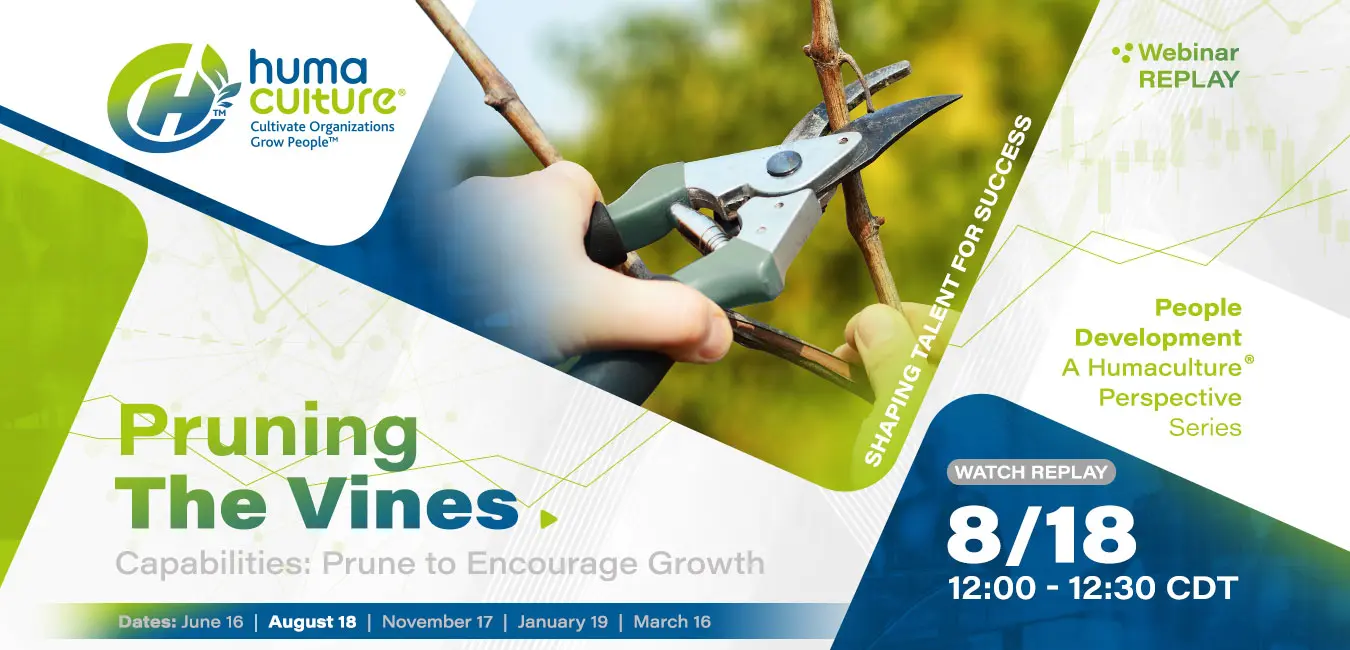
Watch a replay of the second webinar in Humaculture, Inc.’s “People Development: A Humaculture® Perspective Series”, to learn how to shape talent for success by “Pruning the Vines,” using capabilities to prune to encourage growth so employees to fulfill their potential and maximize alignment and productivity.
Presenters
- Steve Cyboran, ASA, MAAA, FCA, CEBS, actuary and strategy consultant
- Wes Rogers, Humaculturist® and strategy consultant
- Christi Green, RN, MS, PHR, strategy and people consultant
Prune to Encourage Growth Objective
This webinar explores ways organizations can “Prune to Encourage Growth” to shape talent for the future. Capabilities can be used to help organizations select the best plants, determine how best to organize them in the garden, identify strengths and weaknesses, prune away distractions (weak branches) to encourage growth and fruit production.
Key Takeaways
During this session, participants will learn that:
- Competencies tend to be just a checklist of skills to manage
- People that focus on everything may not be very good at anything
- Highly skilled employees may not thrive in management or leadership
- Effective people development:
- Is rooted in a clear understanding of organizational vision
- Facilitates growth, supports optimal organizational (garden) design
- Assesses skills and needs to support strategic priorities
- Explores the employee’s interests, abilities, and desires
- Identifies potential for transitions, management, or leadership
- Applies principles that work
Available Support
We are available to support you in your strategy, design, compliance, financial, and monitoring needs. Our team includes business and human relations leaders, finance experts, actuaries, clinicians, behavioral health experts, pharmacy experts, and legal resources to guide you through the strategy and compliance process. Please contact us: [email protected].
Watch
Watch the Shaping Talent for Success: Pruning the Vines – Capabilities: Prune to Encourage Growth Webinar Replay below, or via Rumble or YouTube.
People Development: A Humaculture® Perspective Series
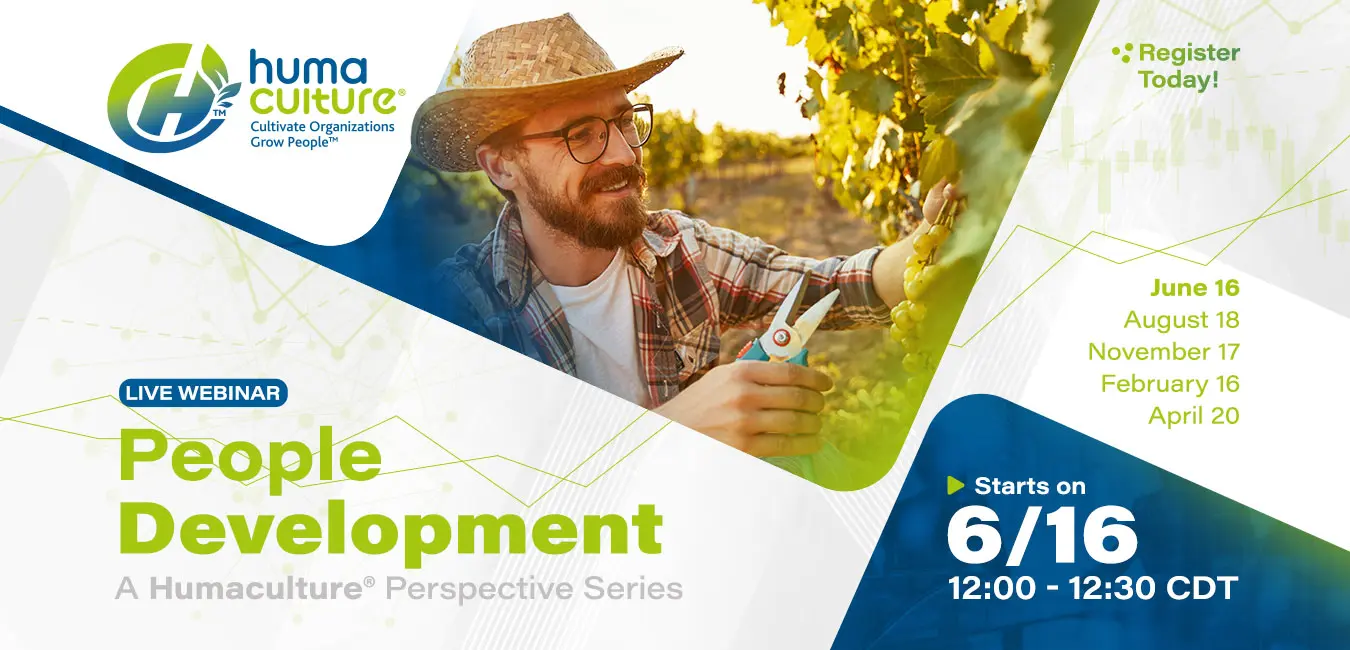
Please join us on the third Thursday of the month over the next six months for our upcoming People Development series. This series will focus on how to shape talent for success by “pruning the vines” as necessary. We will cover people development from the Humaculture® perspective.
In this webinar series, we explore ways organizations can rethink the traditional performance management and people development processes to make them more meaningful, impactful, and aligned with the organizational vision and strategy – focusing employees and leaders on what is truly important.
Successful horticulturists recognize the overwhelmingly positive impact of pruning. Pruning is the process of removing branches that:
- Are not supporting the desired shape of the plant the horticulturist seeks,
- Take energy from the plant without maximizing productivity,
- Shade or otherwise interfere with the productivity of the other branches.
Effective pruning allows the plant to focus its energies in the most effective and productive areas. People, like plants, often expend energy and time in areas that distract them from achieving their highest and greatest purpose and contributions. In any organization, it is important to help employees remove or overcome the impediments that hold them back, and focus on the areas and interests that will really help them achieve their goals, as well as the strategic priorities of the organization. This series highlights several ways organizations can be innovative and more effective than traditional “performance management.”
The topics for the upcoming series include:
| Performance Management: Walking the Garden | |
| June 16, 2022 – 12:00-12:30 CDT | The shift from Managing to Facilitating Growth |
| Shaping Talent for Success: Pruning the Vines | |
| August 18, 2022 – 12:00-12:30 CDT | Capabilities: Prune to Encourage Growth |
| Career Planning: Effective Pruning Bears Fruit | |
| November 17, 2022 – 12:00-12:30 CDT | Employee Development |
| February 16, 2023 – 12:00-12:30 CDT | Manager Development |
| April 20, 2023 – 12:00-12:30 CDT | Leadership Development |
To view our prior Strategic Compliance series on the Hidden Opportunities within the CAA and Transparency Rules, click here.
Available Support
We are available to support you in your strategy, design, compliance, financial, and monitoring needs. To that end, our team of consultants, including actuaries, clinicians, behavioral health, pharmacy, and legal resources are available to guide you through the compliance process. Please contact us.


