
Are You Next in Line for a Fiduciary Lawsuit Over Your Supplemental Health Plans?
A Humaculture® Perspective on Prudent Governance and Created Value
Date: March 10, 2026
Prepared by Humaculture, Inc.
Introduction
Recent ERISA litigation has brought new attention to ERISA fiduciary risks for plan sponsors who manage supplemental health plans. These voluntary benefits include critical illness, accident, and hospital indemnity coverage. In December 2025, class action lawsuits filed by Schlichter Bogard & Denton named both employers and their benefits consultants as defendants. The complaints alleged fiduciary breaches tied to plan oversight, fee reasonableness, and potential conflicts of interest. Cases targeted organizations such as United Airlines, CommonSpirit Health, Allied Universal, and LabCorp. These actions mark an expansion of ERISA scrutiny into health and welfare benefits.
Humaculture, Inc. approaches these challenges with the Humaculture® Topological Model. This framework rests on the maxim “feed the soil, not the plant.” Leaders cultivate the Organization Domain through Processes and Structures as enabling “soil.” This approach empowers People, like “plants,” to thrive within the broader Environment, including Rules (e.g., laws and regulations), and produce sustainable Created Value.
Strong fiduciary governance in benefits programs supports the delivery of the Three Promises as outcomes of the Humaculture® Topological Model: Effectual (tangible risk reduction and compliance), Emotional (trust and fairness), and Economic (cost efficiency and resource optimization).
High-Risk Profile for Supplemental Health Plan Litigation
Industry analysis and patterns from recent cases, including insights referenced in the “Blindsided” paper from Employees First, suggest organizations with the following characteristics face particularly elevated risk:
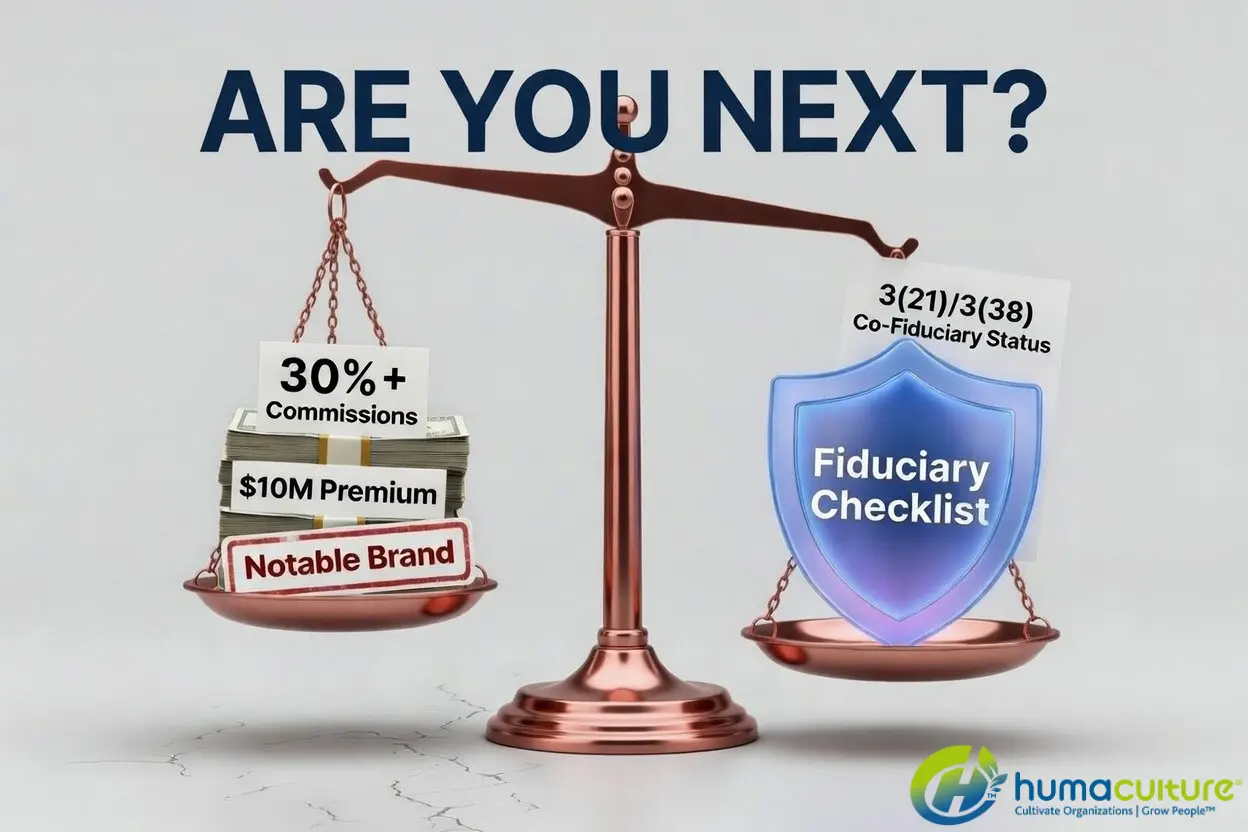
- Broker compensation equals or exceeds 30% of premium
- Total annual premium volume equals or exceeds $10 million
- High-visibility, nationally recognized brand
If your organization matches this profile, proactive review of fiduciary processes is especially urgent.
Parallel Developments with Retirement Plans
The current wave of supplemental health plan litigation follows the same path that transformed retirement plans over the last two decades. ERISA established the fiduciary framework in 1974. The Pension Protection Act of 2006 and the Tussey v. ABB case in 2012 exposed breaches in recordkeeping and revenue sharing. A wave of excessive fee lawsuits followed, making competitive RFPs, benchmarking, full fee disclosure, and co-fiduciary advisors the new standard. The same combination of legislation plus litigation is now driving a similar paradigm shift in health and welfare benefits. The message is clear: what happened in retirement plans is now happening in supplemental health plans.
ERISA Fiduciary Risks: Actionable Checklist for Plan Sponsors
The checklist below helps Plan Sponsors strengthen their practices to fulfill their fiduciary responsibility for supplemental health plans. Proactive steps reduce litigation exposure. The proactive steps also enhance Well-being as a contributor to productivity, support Merit-Based Talent Cultivation, and build organizational resilience.
The “Blindsided” paper from Employees First (June 2025) was referenced in each of these lawsuits, both in the narrative and footnotes, as supporting context for longstanding concerns about these issues. The paper focuses primarily on employers as plan sponsors because the document is geared toward them as the ultimate fiduciaries under ERISA. While the lawsuits name four consultants/brokers (Mercer, Gallagher, Lockton, and WTW) as co-defendants, the paper emphasizes employers’ responsibility to oversee and select advisors prudently. It argues that plan sponsors bear the primary duty to act in participants’ best interests, even if consultants contribute to issues like excessive fees or conflicts. The root cause is often portrayed as a systemic failure in fiduciary processes, but the paper prioritizes actionable steps for employers rather than assigning blame to brokers, to empower sponsors to mitigate risks independently.
Fiduciary Risk Mitigation Checklist for Supplemental Health Plans
Apply this checklist during annual reviews, vendor evaluations, or plan design updates. Document decisions thoroughly to create a prudent process trail.
- Strengthen Governance Through Dedicated Structures
- Form or reinforce a benefits committee with a clear charter. The charter must emphasize ERISA duties of prudence, loyalty, and exclusive participant benefit.
- Include independent expertise and establish Processes for regular training.
- Action Item: Schedule annual fiduciary education and review committee composition within 60 days.
- Formalize Vendor and Consultant Selection Processes
- Conduct competitive requests for proposals with full compensation disclosure, including all overrides, production credits, and revenue-sharing arrangements.
- Prioritize fee-only advisors willing to accept co-fiduciary status under ERISA sections 3(21) or 3(38) to minimize conflicts.
- Action Item: Initiate an RFP cycle if current arrangements exceed three years.
- Ensure Fee Reasonableness and Transparency
- Identify, itemize, and benchmark all fees, services, overrides, production credits, and potential outcomes against industry standards to maximize participant Created Value. Ensure supplemental health plans are not paying a disproportionate share of administrative services.
- Evaluate claims payout ratios and overall participant value.
- Action Item: Engage independent benchmarking and negotiate adjustments where costs appear excessive.
- Align Plan Design with Participant Needs and Created Value
- Confirm offerings provide meaningful, non-duplicative coverage.
- Deliver clear, annual disclosures on costs, benefits, and oversight.
- Action Item: Update Summary Plan Descriptions and gather participant feedback via surveys.
- Embed Ongoing Monitoring via Enabling Processes
- Establish quarterly performance metrics for enrollment, claims efficiency, and satisfaction.
- Use information gathered from Performance Nurturing process to adapt offerings dynamically.
- Action Item: Implement monitoring dashboards and schedule regular committee discussions.
- Secure Protections and Continuous Adaptation
- Maintain robust fiduciary liability coverage that includes health plans.
- Develop response protocols for regulatory inquiries.
- Action Item: Conduct an annual insurance review and consider a simulated fiduciary audit.
How Humaculture® Can Support Your Organization
Humaculture, Inc. helps leaders cultivate resilient organizations with the Humaculture® Topological Model and tools such as the HARS™ (Health, Absence, Resilience Support) framework. We offer independent assessments of total rewards programs, including supplemental health plan governance, without the product sales conflicts of many brokers and consultants. Explore our full range of services and support options.
Independent Consultant vs. Traditional Broker
The choice of advisor is one of the most important Processes in the Organization Domain. Choosing an independent consultant instead of a traditional broker is a direct way to “feed the soil” of strong fiduciary governance. Here is how the two approaches compare:
Note: Many large firms that market themselves as “consultants” continue to earn the majority of revenue from carrier commissions, overrides, and production-based fees — operating with the same conflicts as traditional brokers. True independence requires client-paid fees only and acceptance of co-fiduciary responsibility.
| Aspect | Independent Consultant | Traditional Broker |
|---|---|---|
| Type of Firm | Professional advisory firm licensed to advise on insurance | Insurance agency or brokerage |
| Primary Revenue Source | Client-paid fees | Carrier-paid commissions |
| Pricing Model | Fixed or project-based fees | Percentage of premium (typically 25–40%) |
| Revenue Sharing / Overrides | None | Common (overrides, sales quotas, production bonuses) |
| Represents | The plan sponsor / client | The insurance carriers |
| Primary Focus | Strategic design, participant outcomes, Created Value | Product placement and premium volume |
| Service Style | Comprehensive RFP, actuarial analysis, ongoing monitoring | Transactional renewals and carrier-driven |
| Summary | Unbiased strategic guidance serving only client interests | Services designed to support product sales and servicing |
ERISA Fiduciary Risks Alignment with the Humaculture® Topological Model
The table below shows how an independent consultant strengthens the Organization Domain in the Humaculture® Topological Model by feeding the soil of clean Processes. In short, the broker model fails to recognize how Processes enable healthy Connections between the Organization Domain and People, creating unintended consequences.
| Aspect | Humaculture® Alignment | Practical Outcome in the Model |
|---|---|---|
| Primary Revenue Source & Pricing Model | Client-paid fees vs. carrier commissions | Clean “soil” (no hidden conflicts) vs. contaminated “soil” |
| Revenue Sharing / Overrides | None vs. common overrides | Protects integrity of the fiduciary Processes vs. self-dealing |
| Represents | Plan sponsor vs. insurance carriers | Feeds loyalty and prudence vs. violates exclusive-benefit rule |
| Primary Focus & Service Style | Strategic design and Created Value vs. product placement | Nurtures Created Value vs. treats People as sales opportunity |
| Summary | Unbiased guidance vs. product sales support | Cultivates resilient Organization Domain vs. creates unintended consequences |
Our services cover fiduciary process audits aligned with the Dynamic Matrix, evidence-based plan design recommendations, actuarial-supported ROI modeling for benefits investments, and Cultural Nurturing strategies to enhance engagement and Well-being.
We focus on Merit-Based Talent Cultivation and Equality of Opportunity to deliver balanced outcomes in each of the Three Promises.
ERISA Fiduciary Risks Summary
The evolving ERISA landscape calls for robust, documented fiduciary Processes in supplemental health plans. Leaders who proactively feed the soil through strong governance reduce legal risks and unlock greater Created Value. This includes lower costs, higher resilience, and sustained productivity. Read more of our insights on organizational resilience.
Humaculture, Inc. stands ready to partner with you on this cultivation journey. Contact us to discuss a customized assessment or explore how the Humaculture® Topological Model can optimize your total rewards strategy.
Contact: Steve Cyboran at [email protected], Wes Rogers at [email protected], or Caroline Cyboran at [email protected]
Website: humaculture.com
LinkedIn: humaculture-inc


